
Publisher reading guidance checked; added original practice diagrams with text descriptions and explained answers.
If a reply seems to arrive before its question, you may have read the balloons or panels in the wrong order. Start by checking the edition's reading direction, then follow one page at a time. You do not need to decode every visual detail on your first pass.
These three original exercises introduce a regular panel grid, a conversation, and a pair of facing pages. Each has a complete text description and an answer, so you can practice without relying on the images. The diagrams demonstrate simple arrangements; real manga can use more complex compositions.
Check the edition before choosing a direction
Many English editions preserve Japanese right-to-left page flow. VIZ explains that this preserves the intended movement between panels and pages. For a book in that format, the front cover sits with the spine on your right. Follow any reading instructions printed in your copy.
It is not a rule for every comic marketed as manga. Scholastic's manga reading guide explicitly discusses both right-to-left and left-to-right editions. A familiar title, art style, or digital storefront does not establish direction by itself.
On a screen, distinguish the page's reading direction from the app's controls. Use the reader's instructions for moving forward. A swipe direction or a scroll setting is not evidence that the panels within a displayed page should be read differently.
Separate the page, the panel, and the balloon
A panel is a framed or otherwise defined part of the page. A gutter is the space between panels. A speech balloon holds dialogue; its tail commonly points toward the speaker. Captions may provide narration, and lettering outside balloons may represent sound effects or other information.
Cartoonist Nate Powell's explanation of comics for Scholastic Art describes how panel arrangements, gutters, and text work together. Look at the pictures as well as the words: a changed expression or an object entering the frame may supply information the dialogue never states.
Treat reading as three connected decisions: which page, which panel, and which piece of text inside that panel. Confusion often comes from switching to the next panel before finishing the one you are in.
Exercise one: follow a regular panel grid
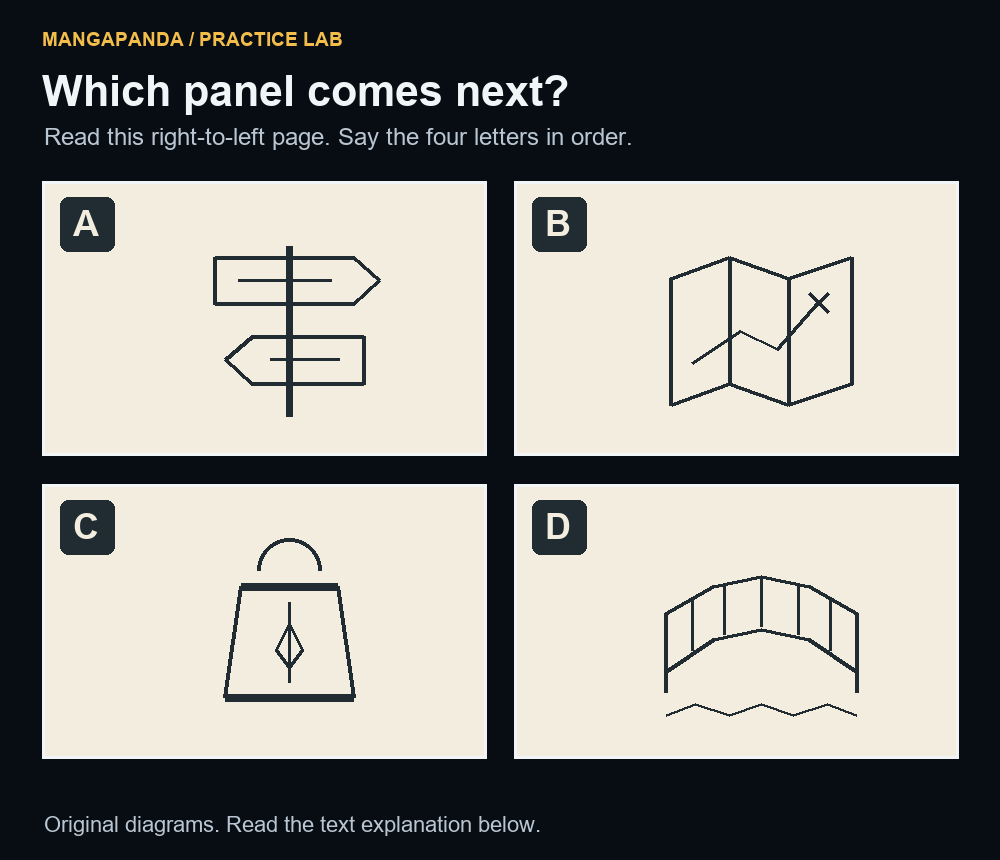
This is a single right-to-left page with four equal panels in two rows. The top-left panel is labeled A, top-right B, bottom-left C, and bottom-right D. Clear gutters separate the rows and columns. The letters identify panels; they are not sequence numbers.
Starting at the upper-right corner, which letter do you read first? Where do you go after the top row?

Answer: B, A, D, C. Read across the top row from right to left, return to the right side of the next row, and read that row. You do not read down the entire right column first in this regular grid. The distinct horizontal row boundary makes the intended grouping clear.
Try tracing the route once with a finger or cursor, then looking away and recalling the four positions. This is practice for a simple layout, not an instruction to force every page into rows of equal height.
Exercise two: identify the speaker and the response
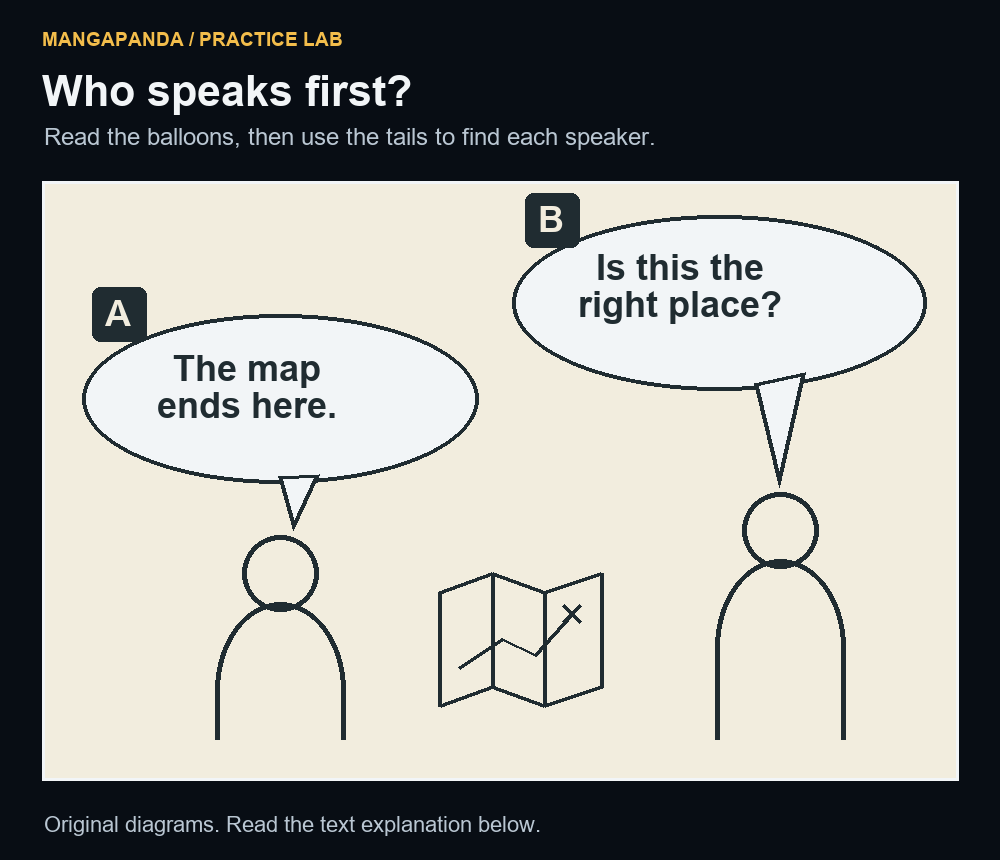
This exercise contains one panel and two simple figures. Balloon B is at the upper right and says, “Is this the right place?” Balloon A is slightly lower and to the left and says, “The map ends here.” Each balloon has a tail pointing toward its speaker.
Which balloon comes first? What do the tails help you establish?

Answer: B, then A. In this deliberately simple arrangement, follow the upper-right balloon toward the lower-left reply. The tails identify who speaks. They do not by themselves supply a universal chronology: a character standing farther right is not automatically the first speaker in every conversation.
Read the English words inside each balloon in normal English order. Right-to-left panel flow does not mean reversing a translated sentence. After the dialogue, take another look at the figures and setting before moving to the next panel.
Exercise three: keep facing pages separate
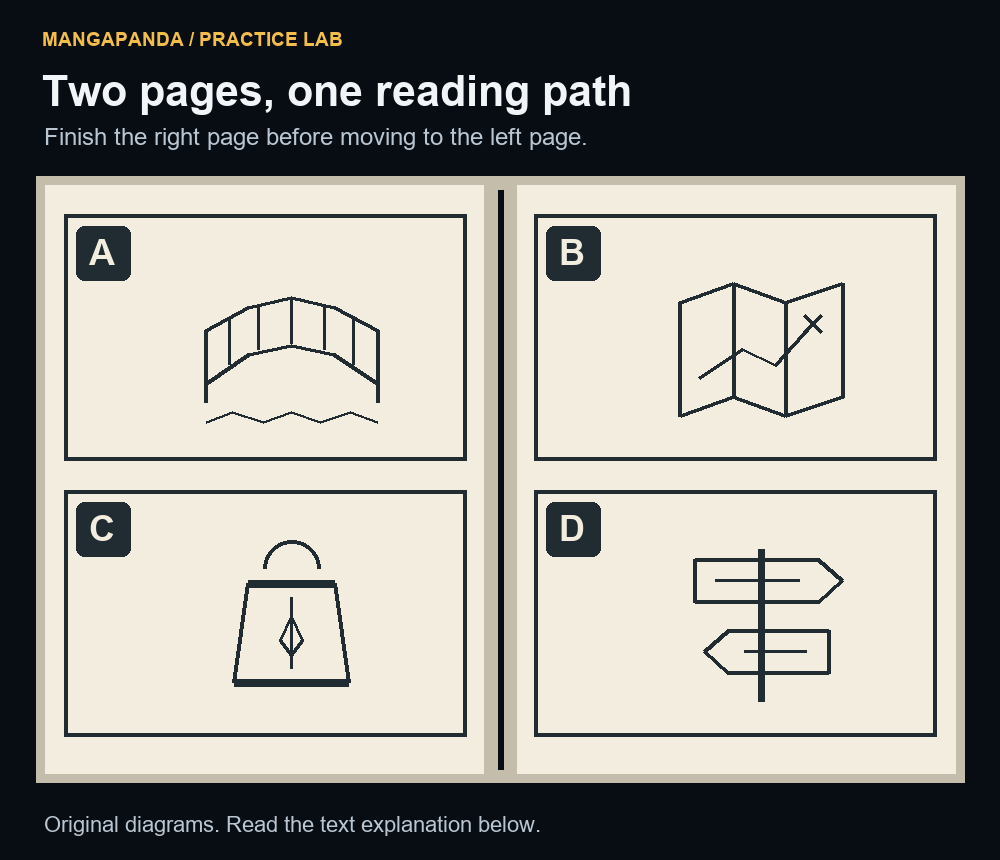
Imagine an open right-to-left book. The right-hand page has panel B at the top and D below it. The left-hand page has panel A at the top and C below it. A clear central gutter separates the pages, and no panel extends across that gutter.
Do you read both upper panels before both lower panels, or finish one page first?

Answer: B, D, A, C. Finish the right page from top to bottom, then move to the left page. Reading B, A, D, C would jump between separate pages before finishing either one.
This exercise shows two facing pages, not a single drawing or panel that spans both. When artwork deliberately crosses the center, first identify the actual panel boundaries and any text sequence. Do not split one continuous image simply because a binding or screen seam runs through it.
What changes on an irregular page?
Real pages can include tall panels beside smaller ones, overlapping frames, or images that reach the page edge. Powell notes that irregular arrangements can change pace and focus. A simple “pick whatever is farthest right” rule cannot account for every composition.
When you lose the sequence, zoom out or view the whole page. Find the last panel you understood, look for the next grouping of frames, and reread the short passage. Check whether you accidentally skipped a balloon or crossed to the facing page. If two orders still seem possible, keep that uncertainty rather than inventing an event to make one route work.
Give silent panels time
A panel without dialogue still belongs in the sequence. Look for what has changed: a hand moving, someone turning away, an empty chair, a wider view of the setting. Those details can connect the surrounding panels.
There is no required number of seconds to spend on a silent panel. Pause long enough to notice its information, then continue. A blank background or a dramatic expression does not carry one guaranteed meaning across all artists and stories; use the scene around it.
Vertical-scroll comics follow their own presentation
WEBTOON's creator handbook describes comics composed for a vertical mobile format. In that presentation, follow the sequence downward as it is revealed. Do not impose the two-page exercise on a continuous strip.
A print edition and a scrolling edition can present material differently. Our manga formats guide helps identify what you have, while the first-series guide helps choose a manageable beginning. If you want a clear finish line, the completed short-manga edition comparison is another place to start.
For your next official preview, check the direction, finish each panel's text and artwork, and reread any exchange that stops making sense. The aim is to follow the story comfortably, with permission to slow down when the page asks for more attention.